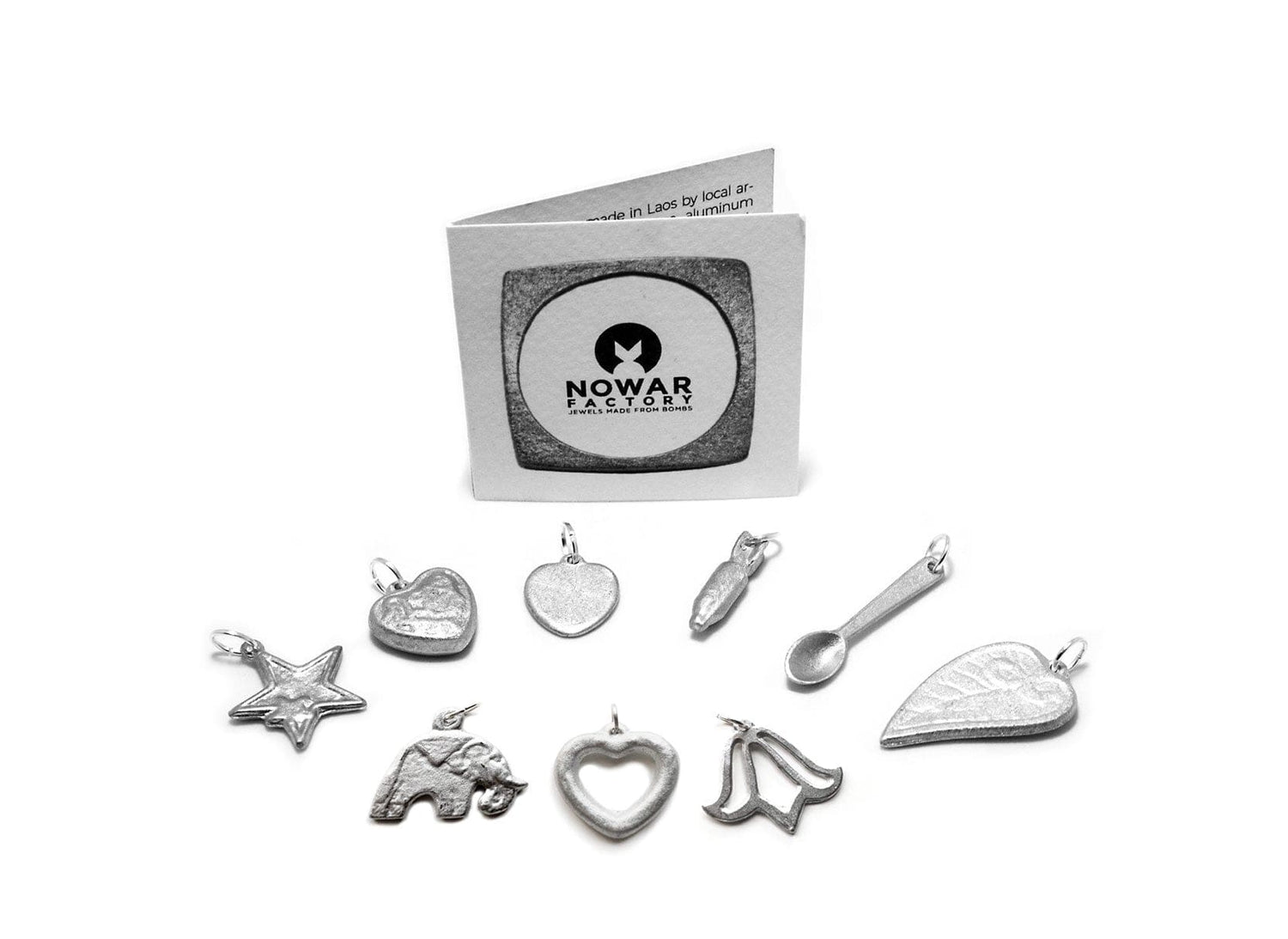


From war to beauty: how a piece of jewellery is made in Laos
Every piece of jewellery has a final form.
But not all of them carry a story like this one.
In Laos, some jewellery is born from a process that combines memory, craftsmanship and transformation.
Materials marked by war are recovered, melted down and worked by hand until they become objects to wear every day.
This is not just production.
It is a change of meaning.
→ Circle of Life Necklace — recycled aluminium from war ordnance in Laos, handmade. €35.90
📍 Where it all begins
Laos is one of those places where the past continues to leave concrete traces in the present.
In the village of Ban Naphia, in the province of Xieng Khouang — one of the areas most heavily bombed — Mr. Phet and his wife collect metal from already-detonated bombs in cleared zones and transform it by hand into individual pieces of jewellery.
What elsewhere would be mere scrap, here becomes raw material to start again.

🔨 How the process begins
Everything starts with the collection of material, recovered through local networks tied to reuse and land clearance.
The metal is selected, prepared and brought to the smelting stage. From that point on, a slow, manual, precise process begins.
The artisan's hand is central at every step:
- material collection
- smelting using the sand-casting technique
- shaping
- final finishing
Each phase leaves visible marks.
Each piece retains its own character.
Read more:
Recycled materials in jewellery

🧵 The value of handmade work
These pieces do not come from impersonal production.
They come from hands, time and skills passed down through generations.
Every hammer strike, every mark, every finish tells of the human presence inside the object.
💣 When the material changes meaning
The most powerful point is not only aesthetic.
It is symbolic.
Materials that once belonged to a logic of destruction are transformed into something that accompanies the body, memory and daily life.
This is not just recycling.
It is reconversion.
Read the full story:
Jewellery made from bombs
🪶 Nickel-free by nature
The recycled aluminium from these ordnance is naturally nickel-free and hypoallergenic. A piece that carries a story of transformation is also safe for the most sensitive skin.
Read more:
Nickel-free jewellery: what it is and why it matters

🌱 Why this process actually matters
Understanding how a piece of jewellery is made also means understanding what you are choosing to wear.
- reduced waste
- recognition of human labour
- symbolic transformation of material
- connection between object and history
Find out what responsible jewellery means:
Responsible jewellery

🔗 Read more
- Ban Naphia: the village where bombs become jewellery
- UXO Lao: the most bombed country in the world
- Jewellery made from recovered materials
- Nickel-free jewellery
- Wearing a message
❓ Frequently asked questions
How is a piece of jewellery made in Laos?
It is made through a handcraft process that includes material collection, smelting, shaping and manual finishing. The technique used is called sand casting.
Are the pieces handmade?
Yes. Handcraft work is an essential part of their identity.
Are they safe for sensitive skin?
Yes. Aluminium is naturally nickel-free and hypoallergenic.
What you wear is not the only thing that matters.
Where it comes from, how it was made, and what it managed to become — that matters too.